LV
2
- Joined
- Mar 5, 2026
- Messages
- 57
- Reaction score
- 74
- Points
- 38
Can you tell me more about what you want?Bro can u release any auto patcher as well?
thank you



Can you tell me more about what you want?Bro can u release any auto patcher as well?
thank you
Hahaha, "without years of previous knowledge" is a big statement for the history of agent development, which only started to do something worthwhile in 2025.We all have ai it's not hard to ask/create something like this xD
If you aren't using AI alexst might agree probably isn't worth the effort to use his files over mothanna's.
--
I forked and am working implementing top2 stuff on these files. Might share, but there are some pretty complicated issues you probably wouldn't be able to navigate without years of previous knowledge and or opus 4.8/codex 5.5. And strong knowledge on agentic ai use to effectively make it work.

Actually any type of auto patcher since there is no guide for thatCan you tell me more about what you want?


I don't know.Alex I was taking to a friend they said this might be completely rewriteable in rust. Haven't actually given it any thought but wanted to see what you thought.
I'm going to investigate I'll post my findings.
 Data is also a void*, which breaks the encrypted record stride on x64. I read these through a mirror with the on-disk stride derived from the record count rather than sizeof, because tail-padding on x64 makes a sizeof-based guess wrong for any table whose derived fields aren't an 8-byte multiple (that one cost me a crash before I figured it out).
Forget about this reply, sorry bro.
Anyway, I’ve managed to get an x64 build working with help from Claude, Cursor, and some commits from — things like the font system, LuaJIT, LuaBridge, and VS2026 / v145. Thanks a lot for that. Also, the idea of using SQLite was a big breakthrough for me.
That said, I’m now running into some new issues:
- Some scene objects don’t seem to render properly. Certain buildings, fences, and even stairs are missing or appear transparent. I’m not sure if this is related to textures or something else.
- A health bar below the 100%, also no idea to start with. My Claude and Cursor are starting to drift off to the sea — like a pirate
- FPS can go above 60 (120–144+). It seems to work, but it feels off — character movement looks weird (walking/running doesn’t feel right). I’ll probably leave this for now.
- Mall buttons still bugs, maybe next after everything done.
View attachment 446
Big thanks for everyone.
Say hello to Montana and his source hahaha))Make sure you check the discord app ID that's baked in to your files alex rofl cheeky shit right there
I think I'll not share how to fix this one see who the real ones are to figure out where to change this one hahaha, gj Montana pwning nabsSay hello to Montana and his source hahaha))


Say hello to Montana and his source hahaha))
 funny fact we shared what been leaked so the discord id not mine either but i pushed it as empty in other github but its simple to change so things is good to go
![[TwT]~Darkness](/data/avatars/m/0/213.jpg?1774049328)
Hola!Hi
I'm presenting my version of Pirate King Online (PKO), which will be actively developed with ongoing bug fixes.
My version of PKO is now very different from https://pkodev.com/threads/tales-of-pirate-2022-dx9.126/, although it was originally based on it.
- The networking layer has been completely rewritten and is now in the CorsairsNet project.
- The protocol has been changed from binary to msgpack, so now you can print all packet data for debugging.
- Nothing is read from or written to packets directly anymore — serialization/deserialization is used instead, which guarantees there will be no network errors on the client or server side.
- All packets are covered by tests.
- GateServer, GroupServer, and AccountServer have been rewritten in .NET (F#).
- GateServer will be able to handle as many clients as your machine can support.
- SQL injection vulnerabilities have been completely eliminated in the .NET servers.
- A unified logging system based on C++20 has been added to the C++ projects, replacing the unsafe sprintf-based approach.
- Lua has been updated to the latest LuaJIT & LuaBridge, so now you can add and call functions cleanly.
- LuaBridge will now clearly show and report all errors that previously went unnoticed because CaLua silently ignored them.
- It will no longer be possible to accidentally pass a Character* to a function expecting an Npc* in Lua.
- The Lua calling system has been completely rewritten, and manual attribute checking has been removed.
Coming soon:
- All txt/bin tables will be dropped in favor of a unified string data loading system based on embedded SQLite.
- The server and client will be migrated to x64.
- DirectX will be upgraded from version 9 to 10.
- An asset pack storage system will be added.
- Tools for working with game resources will be added directly to the solution.
P.S. Feel free to create bug reports — I'll be fixing them from time to time. Pull requests are welcome!)
1. You can't use the original mhontana files because the game now uses a different protocol, msgpack. The network part has been heavily refactored and tested.Hola!
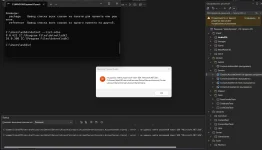
Listen, maybe u can explain what happends with my broken hands?
cuz im trying to rendered gate\acc\group cuz in folder only game cfg files.
and?
and i have million problem.
SDK connot be readed. sdk not dound. im downloaded 8\10 version during to list inside github. and? nothing !
how to fix this shit ? maybe someone knows?
View attachment 593
maybe need to update full c++ with full staff 50+ GB? or what....
or i can using acc\group\gate from the mhontana main project? just copy past?
1. You can't use the original mhontana files because the game now uses a different protocol, msgpack. The network part has been heavily refactored and tested.
2. You need to install .NET support in the studio, as indicated in the solution explorer.
Thanks a lot)1. You can't use the original mhontana files because the game now uses a different protocol, msgpack. The network part has been heavily refactored and tested.
2. You need to install .NET support in the studio, as indicated in the solution explorer.
Bro these files need way more work than updating your vbThe thing is, I updated Visual Studio 4GB, then updated it again with the missing components. Then I installed additional SDK versions separately. Now I'm updating C++ again. I hope it works.
Thanks a lot)